Peter Obi, Tinubu and the 2027 battle over Nigeria’s economic record
Peter Obi has made Nigeria’s economic hardship the centre of his 2027 challenge to President Bola Tinubu. The Presidency’s response to one of his historical claims shows why both sides will be judged on evidence, not only rhetoric.
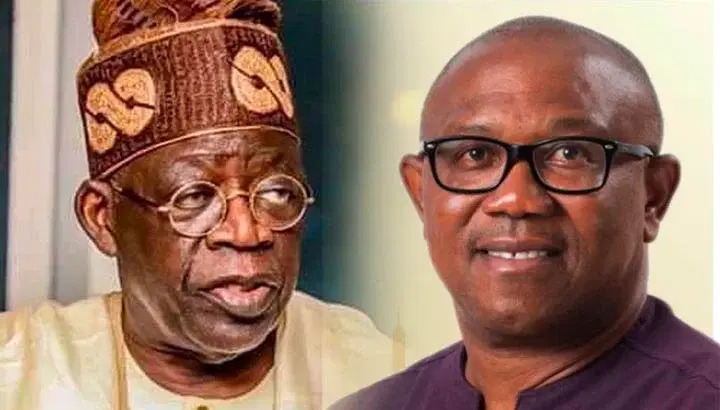
Peter Obi’s 2027 argument rests on a compelling diagnosis of hardship. But the Presidency’s attack on one of his historical claims shows why the opposition’s credibility will depend as much on evidence as on emotion.
Peter Obi’s message in Aba was blunt: President Bola Tinubu had failed to deliver, poverty had deepened, borrowing had risen without visible returns, and Nigerians should remove the administration in 2027. Speaking at a campaign event reported by PUNCH, the NDC presidential candidate promised a government with Senator Rabiu Kwankwaso that would move Nigeria “from consumption to production,” invest in education and healthcare, and generate, transmit and distribute at least 10,000MW of electricity.
The Presidency’s response did not engage the full economic programme. Instead, it seized on Obi’s reported claim that Nigeria under President Shehu Shagari helped South Korea pay workers’ salaries. Bayo Onanuga, the President’s Special Adviser on Information and Strategy, called the account false, saying Nigeria’s foreign salary assistance occurred under General Yakubu Gowon and involved Grenada, not South Korea.
That rebuttal matters because it shifts the argument from policy disagreement to factual credibility. Yet it also risks obscuring a more difficult question for the Presidency: whether Obi’s central economic indictment survives scrutiny even where individual claims require correction.
The competing economic stories
Obi’s campaign narrative is built around a simple proposition: Nigeria’s crisis is not an unavoidable consequence of global conditions, but the product of poor choices, weak production and misallocated public money. In Aba, he argued that Tinubu had failed on power, that public borrowing had produced little to show for it, and that poverty and youth unemployment had worsened.
His proposed remedy is equally recognisable. He wants a government that invests borrowed money in productive assets, expands electricity supply, rebuilds education and healthcare, fights corruption and turns commercial centres such as Aba into export hubs. The political appeal is clear. It offers voters a theory of agency: hardship can be reversed through competent management, investment and a different governing coalition.
The Presidency’s response is narrower but strategically useful. By challenging Obi’s South Korea claim, it can portray him as careless with history and therefore unreliable on economics. Onanuga’s language was personal and severe, describing Obi as someone who “lies as if his life depends on it.” That rhetoric may energise government supporters, but it does not itself resolve whether Tinubu’s economic record has improved ordinary Nigerians’ living conditions.
What the evidence supports
Some of Obi’s claims are supported by credible evidence, though not always in the precise form he used.
The poverty figure is the clearest example. Obi said that 87 million Nigerians were poor when Tinubu came into office and that more than 140 million are poor today. PwC’s 2026 West Africa Economic Outlook projected a 62 per cent poverty rate for 2026, equivalent to about 141 million people, and Daily Trust reported that projection in its fact-check. But FactCheckHub noted that there is no 2026 National Bureau of Statistics survey establishing that more than 140 million Nigerians are currently poor.
That distinction is not pedantry. A projection can be a reasonable basis for policy concern, but it is not the same as a measured current poverty rate. In a campaign environment, the difference matters because opponents can use an overstated claim to discredit an otherwise serious argument about deprivation.
The borrowing claim requires even greater care. Obi said Tinubu had “borrowed more money than all previous governments combined.” The Debt Management Office puts Nigeria’s total public debt at N166.79 trillion, or approximately $120.93 billion, as at 30 June 2026. That is a stock of obligations accumulated by federal and state governments over decades, not a record of new borrowing attributable solely to the Tinubu administration.
The available fact-checking material treats the “Tinubu borrowed more than all previous governments combined” formulation as false or at least highly misleading. The stronger, defensible criticism is different: Nigeria’s debt stock is high, new borrowing plans remain substantial, and debt service constrains fiscal space. The Presidency has sought Senate approval for a supplementary external borrowing plan involving $20.52 billion and €1.05 billion, while the DMO recorded total public debt of N166.79 trillion in June 2026.
The claim the Presidency can win
On the South Korea claim, the Presidency has the stronger documented position, subject to one qualification.
TVC News reported that historical accounts of Nigeria’s foreign policy under Gowon document financial assistance to Grenada and Guyana, including support for civil servants’ salaries in May 1975. It also stated that the account cited by Onanuga does not establish that Nigeria ever undertook to pay South Korean workers’ salaries. In other words, the Presidency has identified a real historical precedent for foreign salary assistance, but its rebuttal does not itself prove every element of Obi’s original claim or disprove it in full.
This is why the episode should not be treated as a simple “Obi lied, Presidency won” story. The available evidence supports the Presidency’s core correction: the named country and administration appear wrong. But the Presidency’s broader attack on Obi’s credibility should not become a substitute for answering the economic questions Obi raised.
A government can accurately correct a historical error and still face a legitimate political challenge over borrowing, inflation, unemployment, insecurity, power supply and the lived experience of reform. Conversely, an opposition candidate can be right about the severity of hardship while weakening his case through imprecise or unverifiable claims.
Why Obi needs precision
Obi’s political strength has always rested partly on his reputation for policy seriousness. His supporters see him as a candidate who speaks in development terms rather than relying only on ethnic or party loyalty. That advantage is fragile if his economic arguments are repeatedly shown to rest on exaggerated statistics or shaky historical examples.
The poverty claim illustrates the danger. “More than 140 million Nigerians live in poverty” is a powerful sentence, but it is stronger as a projection than as a statement of established current fact. The borrowing claim is similarly vulnerable because it conflates a government’s new borrowing with the entire national debt stock.
The 10,000MW pledge presents a different problem. It is not false because it is a promise, but it is analytically thin until Obi explains how generation, transmission, distribution, gas supply, financing, regulation and state-level implementation would combine to deliver it. Nigeria’s electricity crisis is not simply a shortage of announced targets. It is a chain of technical, commercial and institutional failures.
For a candidate positioning himself as the alternative to what he calls a failing administration, precision is not a communications inconvenience. It is part of the product.
The Presidency’s narrower problem
The Presidency’s counterattack may win the immediate news cycle, but it does not fully answer the political problem Obi is trying to exploit.
Nigeria’s debt position is real. The DMO’s June 2026 figure of N166.79 trillion includes domestic and external obligations owed by the Federal Government, state governments and the Federal Capital Territory. Fresh borrowing requests for 2026 and 2027 indicate that the government continues to rely on external financing to support budgets and development plans.
That does not prove Obi’s claim that Tinubu borrowed more than all predecessors combined. It does, however, give the opposition a legitimate basis to ask what the borrowing is purchasing, how it will be repaid, and whether debt service is crowding out spending on health, education, security and productive infrastructure.
The Presidency’s most effective response would therefore be a transparent account of borrowing, project delivery, revenue performance, debt service and poverty trends. A personal attack on Obi may dominate social media, but it leaves the government exposed on the issue voters are most likely to experience directly: prices, jobs, insecurity and public services.
The 2027 calculation
The exchange reveals the kind of campaign Nigeria is likely to see. Obi is attempting to make the election a referendum on economic management and the Tinubu administration’s reform record. The Presidency is attempting to make it a referendum on Obi’s reliability.
Both strategies have political logic. Obi needs to convert widespread hardship into a coherent alternative programme. The Presidency needs to prevent the election from becoming a simple verdict on the cost of living, especially if it can portray its critics as factually unreliable.
But the decisive audience is neither partisan social media nor political elites. It is voters whose assessment will be shaped by whether they believe a candidate understands their circumstances and can plausibly improve them. For that audience, a corrected statistic is less important than a credible explanation of why life remains difficult and what would change under a different government.
What to watch
Three developments will test both camps.
First, whether Obi’s campaign publishes a detailed, sourced economic platform that separates established facts from projections, policy pledges and political rhetoric. His 10,000MW promise, borrowing programme and poverty diagnosis would benefit from that discipline.
Second, whether the Presidency provides a comprehensive public defence of its borrowing and reform record, rather than responding only to individual opposition claims. The DMO’s debt data and the government’s borrowing requests provide the material for such an account.
Third, whether the Obi-Kwankwaso political arrangement acquires organisational substance. Obi spoke in Aba of a government he and Kwankwaso “are seeking to form,” but a credible national challenge requires more than a shared platform: candidate selection, party structures, state networks, funding and a message that travels beyond urban rally audiences.
The immediate controversy may be about South Korea, Shagari and Gowon. The more consequential contest is about whether either side can explain Nigeria’s economic condition accurately enough to earn the trust required to change it.
Further Readings
- PUNCH: 2027: Obi faults Tinubu’s economic record, promises reforms
- TVC News: Presidency slams Peter Obi over claims that Nigeria paid South Korean workers
- Debt Management Office: Nigeria’s total public debt as at June 30, 2026
- Daily Trust fact-check on Obi’s 140 million poverty claim
- FactCheckHub on Obi’s Independence Day claims
- ICIR on Tinubu’s external borrowing request
- Daily Post report on the Presidency’s response